


How to Teach Phonics to ESL Learners
Teaching phonics to ESL learners isn't the same as teaching native English-speaking children. In fact, some of the methods that work brilliantly in mainstream schools can actually make learning harder for beginners.
The biggest difference? Native English-speaking children usually know thousands of English words before they learn to read them. ESL learners often don't. They're learning sounds, vocabulary and meaning simultaneously, so your teaching approach needs to reflect that.
Here's how to help young English learners build strong phonics skills—and why Crystal Clear Phonics (a dedicated Phonics-only curriculum for preschool-aged learners) and Crystal Clear Kids' (an integrative ESL curriculum for school-aged learners) take a slightly different approach.
Start with the Alphabet Song
For most ESL learners, the alphabet song is their first introduction to English.
That's why Crystal Clear Phonics teaches phonemes in alphabetical order, matching the sequence children already recognise. It creates a familiar starting point and makes new learning feel much less intimidating.
One tip: choose an ABC song where every letter is clearly pronounced. Many Western versions rush through L, M, N, O, P, making those letters difficult for beginners to distinguish. Versions popular in Asia are often slower and much clearer.
Keep Your Language Simple
Young beginners are already processing unfamiliar sounds, vocabulary and pronunciation. Long explanations simply overload them.
Use short, consistent instructions such as:
Listen.
Repeat.
Point.
Match.
Circle.
Say it again.
Repeating familiar classroom language helps students absorb useful English naturally while keeping the lesson moving.

Synthetic vs Analytic Phonics
There are two recognised approaches to teaching phonics.
Analytic Phonics
Analytic phonics encourages children to spot patterns between familiar words.
For example:
cat, mat, sat
This works well for many native speakers because they already understand these words.
For beginner ESL learners, however, it can be confusing. They often don't know the vocabulary yet, so recognising spelling patterns becomes much more difficult.
Synthetic Phonics
Synthetic phonics teaches children individual sounds first before blending them together to form words.
For example:
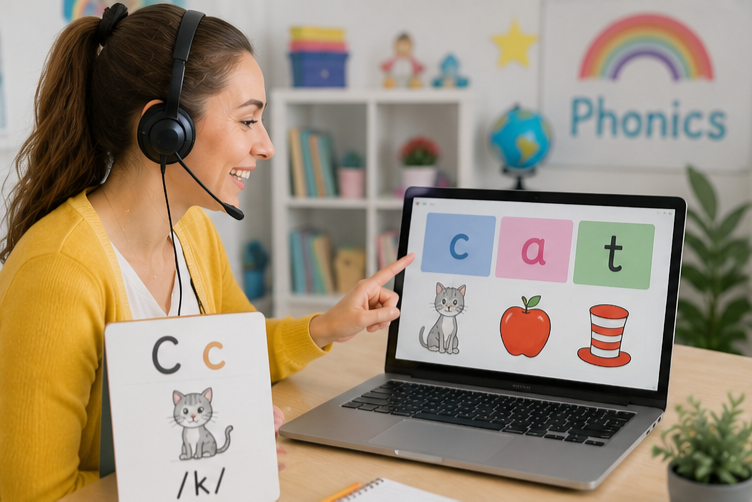
c-a-t
This approach relies less on vocabulary, making it a much better starting point for ESL learners.
However, complete beginners can still struggle with blending several separate sounds, particularly if blending isn't part of literacy instruction in their first language.
That's why Crystal Clear Phonics introduces manageable sound chunks such as:
c-at
before progressing to full blending.
Don't Overuse Nonsense Words
Traditional synthetic phonics often uses "alien words"—made-up words designed purely for blending practice.
While these have their place, ESL learners don't yet have enough vocabulary to know whether a word is real or invented.
For beginners, it's far more valuable to spend time practising words they'll actually hear and use in everyday English.
Letter Names Can Wait
Many teachers worry about drilling letter names from the very beginning.
You don't need to.
Focus first on helping children recognise and produce the sounds each letter makes. Introduce upper- and lower-case letters alongside the sounds naturally rather than expecting students to memorise every letter name immediately.
Why Crystal Clear Phonics Uses a Hybrid Approach
Crystal Clear Phonics combines the strengths of both major teaching methods.
Students first build confidence recognising and blending phonemes using a synthetic approach before gradually introducing wider vocabulary and word families through analytic activities.
The result is a structured programme that develops decoding skills while steadily expanding vocabulary.
Designed for children aged 3–8, every phoneme includes:
a key vocabulary word
a memorable action
a catchy song
interactive activities
opportunities for blending practice
The curriculum covers all 44 English phonemes, beginning with short vowels before progressing through digraphs, r-controlled vowels, long vowels, oo sounds and diphthongs.
Don't Forget Sight Words
Not every English word follows regular phonics rules.
Common sight words should therefore be practised regularly alongside phonics lessons.
Crystal Clear Phonics includes printable flashcards and sight word lists that can be incorporated into games, revision and homework.
Little and often always wins.
Encourage parents to spend just a few minutes each day reviewing flashcards, singing phonics songs or playing one of the curriculum's simple phonics games.
Those small daily sessions make an enormous difference.

Make Repetition Fun
Children need repetition—but they don't need boredom.
Keep practice fresh by mixing activities such as:
actions and movement
puppets
silly voices
echo reading
songs and chants
clapping rhythms
games
friendly competitions
meaningful rewards
Crystal Clear Phonics intentionally revisits sounds in different contexts so students repeatedly practise them without lessons ever feeling repetitive.
Keep Lessons Short
Young learners have short attention spans.
Aim for 25–30 minute phonics lessons packed with energy, movement and interaction, or for preschool children, even 10-15 minutes several times each week is ideal.
For longer classes, combine phonics with vocabulary, speaking practice, games, songs or storytelling to create a varied lesson that keeps children engaged from beginning to end.
Use the Right Technology
To get the most from Crystal Clear Phonics, teach on a PC or Mac rather than a tablet.
The curriculum includes interactive activities such as drag-and-drop, drawing, typing and matching exercises that work best with a mouse.
Choose a virtual classroom platform such as Zoom or Koala that supports screen sharing and remote mouse control so students can interact directly with the lesson rather than simply watching.
Final Thoughts
Teaching phonics to ESL learners requires a different mindset from teaching native English speakers.
By introducing sounds gradually, keeping language simple, making lessons interactive and building vocabulary alongside phonics, you'll give your students the strongest possible foundation for reading and speaking English with confidence.
Crystal Clear Phonics was designed specifically for this journey, combining engaging lessons, songs, games, sight words and interactive activities into a structured curriculum that makes learning fun for both teachers and students.
Ready to give it a try?
Start your free two-week trial today and discover how enjoyable teaching phonics can be.